
My question is: what good is a charter review commission if the majority of those on it are mayor friends, picked by the mayor and council? Isn't this the blind leading the blind? Go back and look at who has been on the past charter review commissions. A lot of the same names keep showing up.
Also, when you allegedly have friends on the Ohio Ethics Commission, what good is it anyway?
Civic Accountability -- Honesty in Local Government II
Moderator: Jim O'Bryan
-
Lori Allen _
- Posts: 2550
- Joined: Wed Jan 28, 2015 2:37 pm
-
Mark Kindt
- Posts: 2654
- Joined: Sat Dec 03, 2016 11:06 am
Re: Civic Accountability -- Honesty in Local Government II
Ms. Allen: I appreciate your cogent observations. Whether or not the city adopts a robust government-in-ethics policy will be up to the pressure of its citizens. We have ample citizen resources to bring that pressure to bear. My goal is to offer some very clear explanations that include the supporting documents. I appreciate all of the documents that you have posted here in the past. Keep up the good work!
-
Mark Kindt
- Posts: 2654
- Joined: Sat Dec 03, 2016 11:06 am
Re: Civic Accountability -- Honesty in Local Government II
I have attached a "Hypothetical Model of Potential Conflicts of Interest" that will help us think about whether some city council members had potential conflicts of interest on December 21, 2015 that should have ordinarily resulted in a recusal or an abstention from voting on the closure of the hospital.
The primary assumption is that the LHA ex officio board members who voted did not have "formal instruction".
The other assumption is that Article Eight of the Third Amended Charter would have applied, but for it being tabled by council.
This is very interesting. Please take a look.
Tomorrow, we will take a look at the issue of "formal instruction" in the context of the May 1, 2015 opinion letter to the city from the Ohio Ethics Commission.
The primary assumption is that the LHA ex officio board members who voted did not have "formal instruction".
The other assumption is that Article Eight of the Third Amended Charter would have applied, but for it being tabled by council.
This is very interesting. Please take a look.
Tomorrow, we will take a look at the issue of "formal instruction" in the context of the May 1, 2015 opinion letter to the city from the Ohio Ethics Commission.
- Attachments
-
- Possible Conflict of Interest Summary.pdf
- (74.42 KiB) Downloaded 279 times
-
Mark Kindt
- Posts: 2654
- Joined: Sat Dec 03, 2016 11:06 am
Re: Civic Accountability -- Honesty in Local Government II
You might find this editorial from the Columbus Dispatch very interesting:
http://www.dispatch.com/content/stories ... tract.html
You might note some similarities with the deal that closed Lakewood Hospital.
Robust government ethics policies protect both the public and public officials.
http://www.dispatch.com/content/stories ... tract.html
You might note some similarities with the deal that closed Lakewood Hospital.
Robust government ethics policies protect both the public and public officials.
-
Mark Kindt
- Posts: 2654
- Joined: Sat Dec 03, 2016 11:06 am
Re: Civic Accountability -- Honesty in Local Government II
I am now going to walk you through why I believe that the council members serving on the LHA board had a duty to abstain or recuse themselves from voting on the deal to close the hospital. Let's stay focused on three points:
1. The city council had more than two years to adopt the Third Amended Charter with the ethical duties set forth in Article Eight.
2. The mayor has testified (in deposition) that he was acting "without instructions" as he conducted the LHA negotiations to close the hospital.
3. After almost two years of public debate, examination and litigation, no written instructions have ever surfaced.
From points no. 2 and no. 3, I am going to speculate and infer that neither of the two council members serving on the LHA board had "instructions" either. And, therefore, had an actual conflict-of-interest (in potential violation of Ohio Revised Code Section 2941.42) that required their abstention or recusal from voting to close the hospital, since such vote related to a public contract. That public contract related to the entity on whose board they were serving.
Over the next several posts, I will walk everyone through some difficult terrain and demonstrate the reasoning behind my conclusion. Next, we will review the key text of the Ohio Ethics Commission opinion letter (May 1, 2015). The full letter is attached above.
1. The city council had more than two years to adopt the Third Amended Charter with the ethical duties set forth in Article Eight.
2. The mayor has testified (in deposition) that he was acting "without instructions" as he conducted the LHA negotiations to close the hospital.
3. After almost two years of public debate, examination and litigation, no written instructions have ever surfaced.
From points no. 2 and no. 3, I am going to speculate and infer that neither of the two council members serving on the LHA board had "instructions" either. And, therefore, had an actual conflict-of-interest (in potential violation of Ohio Revised Code Section 2941.42) that required their abstention or recusal from voting to close the hospital, since such vote related to a public contract. That public contract related to the entity on whose board they were serving.
Over the next several posts, I will walk everyone through some difficult terrain and demonstrate the reasoning behind my conclusion. Next, we will review the key text of the Ohio Ethics Commission opinion letter (May 1, 2015). The full letter is attached above.
-
Mark Kindt
- Posts: 2654
- Joined: Sat Dec 03, 2016 11:06 am
Re: Civic Accountability -- Honesty in Local Government II
Here is the key text from from the Ohio Ethics Commission opinion letter, dated May 1, 2015 (footnotes omitted, relevant text underlined):
“Advisory Opinion No. 93-012 explained that the prohibition of R.C. 2921.42(A)(4) against a public official having an interest in a public contract with his or her own political subdivision does not apply whenever the official serves on the board of directors of a nonprofit corporation that has entered into a public contract with his political subdivision in his "official capacity" as a representative of his political subdivision in order to represent its interests. The Ethics Commission set forth four criteria which must be met in order for a public official to be deemed to serve in his official capacity:
(1) The governmental entity must create or be a participant in the non-profit corporation;
(2) Any public official or employee connected with the jurisdiction . . . may be designated to serve on the non-profit corporation, but the elected legislative authority or the appointing governing body must formally designate the office or position to represent the governmental entity;
(3) The public official or employee must be formally instructed to represent the governmental entity and its interests; ·and
(4) There must be no other conflict of interest on the part of the designated representative.
[text deleted here for clarity of reading]
Accordingly, a city official serving as an ex-officio member of the LHA, in the absence of any other conflict under the Ethics Laws, is not prohibited from participating in decisions regarding the closing of Lakewood Hospital.”
In general, based upon this OEC opinion letter we can argue that in some circumstances public officials are deemed to serve in their official capacity on certain kinds of nonprofit corporate boards. All of the LHA ex officio board members meet the first two criteria established by the OEC (assuming that they were officially appointed under criteria two).
The mayor testified that he had no formal instructions, so he does not meet criteria three. He does not meet criteria four because of the actual conflict described in the May 1, 2015 OEC letter. (As I have asserted previously, the mayor appears to have been in violation of the statute during his participation as a board member on LHA.) If this is indeed the case, then all of the significant negotiations leading to the Letter of Intent and other negotiations conducted well into 2015 were likely in violation of Ohio law.
In the next post, we continue our review of these conflict-of-interest issues as they applied to the city council members serving on the LHA board.
“Advisory Opinion No. 93-012 explained that the prohibition of R.C. 2921.42(A)(4) against a public official having an interest in a public contract with his or her own political subdivision does not apply whenever the official serves on the board of directors of a nonprofit corporation that has entered into a public contract with his political subdivision in his "official capacity" as a representative of his political subdivision in order to represent its interests. The Ethics Commission set forth four criteria which must be met in order for a public official to be deemed to serve in his official capacity:
(1) The governmental entity must create or be a participant in the non-profit corporation;
(2) Any public official or employee connected with the jurisdiction . . . may be designated to serve on the non-profit corporation, but the elected legislative authority or the appointing governing body must formally designate the office or position to represent the governmental entity;
(3) The public official or employee must be formally instructed to represent the governmental entity and its interests; ·and
(4) There must be no other conflict of interest on the part of the designated representative.
[text deleted here for clarity of reading]
Accordingly, a city official serving as an ex-officio member of the LHA, in the absence of any other conflict under the Ethics Laws, is not prohibited from participating in decisions regarding the closing of Lakewood Hospital.”
In general, based upon this OEC opinion letter we can argue that in some circumstances public officials are deemed to serve in their official capacity on certain kinds of nonprofit corporate boards. All of the LHA ex officio board members meet the first two criteria established by the OEC (assuming that they were officially appointed under criteria two).
The mayor testified that he had no formal instructions, so he does not meet criteria three. He does not meet criteria four because of the actual conflict described in the May 1, 2015 OEC letter. (As I have asserted previously, the mayor appears to have been in violation of the statute during his participation as a board member on LHA.) If this is indeed the case, then all of the significant negotiations leading to the Letter of Intent and other negotiations conducted well into 2015 were likely in violation of Ohio law.
In the next post, we continue our review of these conflict-of-interest issues as they applied to the city council members serving on the LHA board.
-
Mark Kindt
- Posts: 2654
- Joined: Sat Dec 03, 2016 11:06 am
Re: Civic Accountability -- Honesty in Local Government II
The OEC opinion letter is discussing the application of Ohio Revised Code Section 2921.42.
Here is the full text of the statute. I have highlighted the relevant provisions.
Here is the full text of the statute. I have highlighted the relevant provisions.
- Attachments
-
- Ohio Revised Code Section 2921.42.pdf
- (47.99 KiB) Downloaded 246 times
-
Mark Kindt
- Posts: 2654
- Joined: Sat Dec 03, 2016 11:06 am
Re: Civic Accountability -- Honesty in Local Government II
Were there ever any “formal instructions” of the sort defined by the Ohio Ethics Commission in its May 2015 letter to the city? No instructions have ever been seen by the public. The mayor says that he didn’t have any. If you have a copy of any, please post them here so we can review and discuss them.
This perfectly exemplifies why the city needs clear ethical policies and regular training related to such policies.
In the absence of formal instructions, the LHA ex officio board members had to comply with Ohio Revised Code Section 2921.42.
They had no other option than complying with the statute to avoid the ethical conflict of interest and the potential misdemeanor penalty risk set forth in the statute.
In summary, I am arguing five points.
1. The major negotiations to close the hospital were conducted by public official(s) in likely violation of Ohio Revised Code Section 2921.42.
2. Public officials were on written notice from the Ohio Ethics Commission that such conduct was likely in violation of Ohio Revised Code Section 2921.42.
3. Public officials had an absolute duty to comply with Ohio Revised Code Section 2921.42.
4. And, despite the written advice of the Ohio Ethics Commission, some public officials voted on December 21, 2015 to approve the Master Agreement in likely violation of Ohio Revised Code Section 2921.42.
5. Other improper conflicts-of-interest may have tainted that vote.
If my analysis is faulty, please post your objections. I would also note that public official had 6 months in order to clarify these duties with the Ohio Ethics Commission prior to the December vote. They did not.
This perfectly exemplifies why the city needs clear ethical policies and regular training related to such policies.
In the absence of formal instructions, the LHA ex officio board members had to comply with Ohio Revised Code Section 2921.42.
They had no other option than complying with the statute to avoid the ethical conflict of interest and the potential misdemeanor penalty risk set forth in the statute.
In summary, I am arguing five points.
1. The major negotiations to close the hospital were conducted by public official(s) in likely violation of Ohio Revised Code Section 2921.42.
2. Public officials were on written notice from the Ohio Ethics Commission that such conduct was likely in violation of Ohio Revised Code Section 2921.42.
3. Public officials had an absolute duty to comply with Ohio Revised Code Section 2921.42.
4. And, despite the written advice of the Ohio Ethics Commission, some public officials voted on December 21, 2015 to approve the Master Agreement in likely violation of Ohio Revised Code Section 2921.42.
5. Other improper conflicts-of-interest may have tainted that vote.
If my analysis is faulty, please post your objections. I would also note that public official had 6 months in order to clarify these duties with the Ohio Ethics Commission prior to the December vote. They did not.
-
Mark Kindt
- Posts: 2654
- Joined: Sat Dec 03, 2016 11:06 am
Re: Civic Accountability -- Honesty in Local Government II
Reasonable Expectations That Every Citizen Should Have For Their Public Servants
1. Avoid even the mere appearance of impropriety in the performance of your duties.
2. Perform your duties in compliance with local, state and federal law.
3. Comply with the written ethical standards of the unit of government you represent.
4. Understand the nature of official conflicts-of-interest and avoid them.
5. Comply with the fiduciary duties required by the unit of government you represent.
6. Comply with the campaign finance laws that apply to you as either a public employee or an elected official.
7. Comply with the written ethical standards that govern your own profession.
8. When in doubt about any of these standards, seek clarification from other qualified individuals.
If you have read these posts this far, you can see that our public officials can't seem to get over any of these very low hurdles. Keep in mind that I am only looking at a single transaction. I really hope we aren't doing anything else like the way we did the hospital shutdown.
1. Avoid even the mere appearance of impropriety in the performance of your duties.
2. Perform your duties in compliance with local, state and federal law.
3. Comply with the written ethical standards of the unit of government you represent.
4. Understand the nature of official conflicts-of-interest and avoid them.
5. Comply with the fiduciary duties required by the unit of government you represent.
6. Comply with the campaign finance laws that apply to you as either a public employee or an elected official.
7. Comply with the written ethical standards that govern your own profession.
8. When in doubt about any of these standards, seek clarification from other qualified individuals.
If you have read these posts this far, you can see that our public officials can't seem to get over any of these very low hurdles. Keep in mind that I am only looking at a single transaction. I really hope we aren't doing anything else like the way we did the hospital shutdown.
-
Mark Kindt
- Posts: 2654
- Joined: Sat Dec 03, 2016 11:06 am
Re: Civic Accountability -- Honesty in Local Government II
Let me try and simplify this:
Since they were acting without "formal instructions", the LHA ex officio board members were acting outside of their "official capacity" and the strictures Ohio Revised Code Section 2921.42 fully applied. The reason that the two ex officio council members would have for not voting would be to avoid the misdemeanor criminal violation.
I also argue that because they are no longer acting in their "official capacity" that the exceptions in the Second Amended Charter (Article XXIII, Section Three) no longer applied, either.
Since they were acting without "formal instructions", the LHA ex officio board members were acting outside of their "official capacity" and the strictures Ohio Revised Code Section 2921.42 fully applied. The reason that the two ex officio council members would have for not voting would be to avoid the misdemeanor criminal violation.
I also argue that because they are no longer acting in their "official capacity" that the exceptions in the Second Amended Charter (Article XXIII, Section Three) no longer applied, either.
-
Mark Kindt
- Posts: 2654
- Joined: Sat Dec 03, 2016 11:06 am
Re: Civic Accountability -- Honesty in Local Government II
While I am describing what appear to be technical violations of Ohio law that are unlikely to ever be prosecuted; these violations had real world consequences in terms of revenue, taxes, and the continuity of hospital services. Had the LHA ex officio board members sought "formal instruction", the rest of city council might have been informed at a much earlier date about the LHA plans for the city.
As I have demonstrated in this series, casualness and carelessness about matters of government ethics come with a steep price tag.
Now, I've reached the point where both the taxpayer lawsuit and the open meeting lawsuit begin. It is not my intention here to review these cases now. Trust that the lawyers who have brought these cases understand the reasons for what they are doing.
If I were a local public official sitting on other boards, I would want to have a very clear understanding of Ohio Revised Code section 2921.42, since some breaches of that statute are felonies. Further, than that, some of the felonies under that statute can also be federal criminal violations, as well. I would also want to consult the Ohio Ethics Commission or my personal lawyer whenever in doubt about these matters.
As I have demonstrated in this series, casualness and carelessness about matters of government ethics come with a steep price tag.
Now, I've reached the point where both the taxpayer lawsuit and the open meeting lawsuit begin. It is not my intention here to review these cases now. Trust that the lawyers who have brought these cases understand the reasons for what they are doing.
If I were a local public official sitting on other boards, I would want to have a very clear understanding of Ohio Revised Code section 2921.42, since some breaches of that statute are felonies. Further, than that, some of the felonies under that statute can also be federal criminal violations, as well. I would also want to consult the Ohio Ethics Commission or my personal lawyer whenever in doubt about these matters.
-
Mark Kindt
- Posts: 2654
- Joined: Sat Dec 03, 2016 11:06 am
Re: Civic Accountability -- Honesty in Local Government II
For completeness sake, here is another OEC opinion letter on the issues of "official capacity" and public officials serving on boards.
- Attachments
-
- OEC Opinion Letter 2-11-1997.pdf
- (684.28 KiB) Downloaded 251 times
-
Mark Kindt
- Posts: 2654
- Joined: Sat Dec 03, 2016 11:06 am
Re: Civic Accountability -- Honesty in Local Government II
The ethical problems, the disclosure problems, and the legal problems are real enough. One way or another we pay for them as citizens and taxpayers. Like I have said previously, the city now faces three lawsuits, others could be brought.
Should a securities law case be brought against the city on behalf of its bondholders, the ethical problems that I have outlined would work to the advantage of the suing bondholders, and, obviously, not the city.
Given the long-standing criteria established by the Ohio Ethics Commission in its opinions, there is a viable argument that the mayor "abandoned" his legal and fiduciary duties to the city. The legal argument would run as follows: the mayor conducted his negotiations with LHA and CCF in an ultra vires manner; that is, he was conducting the negotiations outside of his official capacity and was negotiating only as a private citizen serving as an LHA board member. I have already demonstrated this line of reasoning with my earlier analysis of the OEC opinions.
Much of the conduct that I have described in these series of posts would tend to strongly support a theory of ultra vires conduct:
1. The so-called "decanting plan" and its subsequent implementation (see taxpayers' lawsuit);
2. The LHA/CCF dominated subcommittees that conducted the sham proposal process via the now-vanished Subsidium consulting firm;
3. The failure to appraise assets or rights that the city might have held under various earlier agreement;
4. The failure of the mayor (or other LHA ex officio board members) either to have or to seek formal instructions from city council;
5. The mayor's long-running conflict of interest during most of the key negotiations; and,
6. The exclusion and supression of the proposal (Metro) that was the most beneficial to the long-term interests of the city.
See what I mean? A pretty appealing scenario for a case, isn't it? Especially, in light of Disclosure Problems No. 1 through No. 9. (Described in "Honesty In Local Government I")
What I am describing would be a natural theory of a case for any serious plaintiff's attorney, especially in light of 1.) political contributions made by LHA, LHA board members, or CCF-related individuals, and 2.) the other likely ethical conflicts in city council. A good lawyer could have a field day with all of this.
Should a securities law case be brought against the city on behalf of its bondholders, the ethical problems that I have outlined would work to the advantage of the suing bondholders, and, obviously, not the city.
Given the long-standing criteria established by the Ohio Ethics Commission in its opinions, there is a viable argument that the mayor "abandoned" his legal and fiduciary duties to the city. The legal argument would run as follows: the mayor conducted his negotiations with LHA and CCF in an ultra vires manner; that is, he was conducting the negotiations outside of his official capacity and was negotiating only as a private citizen serving as an LHA board member. I have already demonstrated this line of reasoning with my earlier analysis of the OEC opinions.
Much of the conduct that I have described in these series of posts would tend to strongly support a theory of ultra vires conduct:
1. The so-called "decanting plan" and its subsequent implementation (see taxpayers' lawsuit);
2. The LHA/CCF dominated subcommittees that conducted the sham proposal process via the now-vanished Subsidium consulting firm;
3. The failure to appraise assets or rights that the city might have held under various earlier agreement;
4. The failure of the mayor (or other LHA ex officio board members) either to have or to seek formal instructions from city council;
5. The mayor's long-running conflict of interest during most of the key negotiations; and,
6. The exclusion and supression of the proposal (Metro) that was the most beneficial to the long-term interests of the city.
See what I mean? A pretty appealing scenario for a case, isn't it? Especially, in light of Disclosure Problems No. 1 through No. 9. (Described in "Honesty In Local Government I")
What I am describing would be a natural theory of a case for any serious plaintiff's attorney, especially in light of 1.) political contributions made by LHA, LHA board members, or CCF-related individuals, and 2.) the other likely ethical conflicts in city council. A good lawyer could have a field day with all of this.
-
Mark Kindt
- Posts: 2654
- Joined: Sat Dec 03, 2016 11:06 am
Re: Civic Accountability -- Honesty in Local Government II
I believe that the city administration will not adopt a written ethics-in-government policy. It tabled the one proposed policy that it had due to fears that it might impede the closure of the hospital.
It will not adopt a written ethics-in-government policy because any such policy will impede the operation of the so-called new foundation.
Next week, we will explore this issue in greater detail.
It will not adopt a written ethics-in-government policy because any such policy will impede the operation of the so-called new foundation.
Next week, we will explore this issue in greater detail.
-
Mark Kindt
- Posts: 2654
- Joined: Sat Dec 03, 2016 11:06 am
Re: Civic Accountability -- Honesty in Local Government II
Continuing my review and commentary on ethics and governance problems in Lakewood city government.
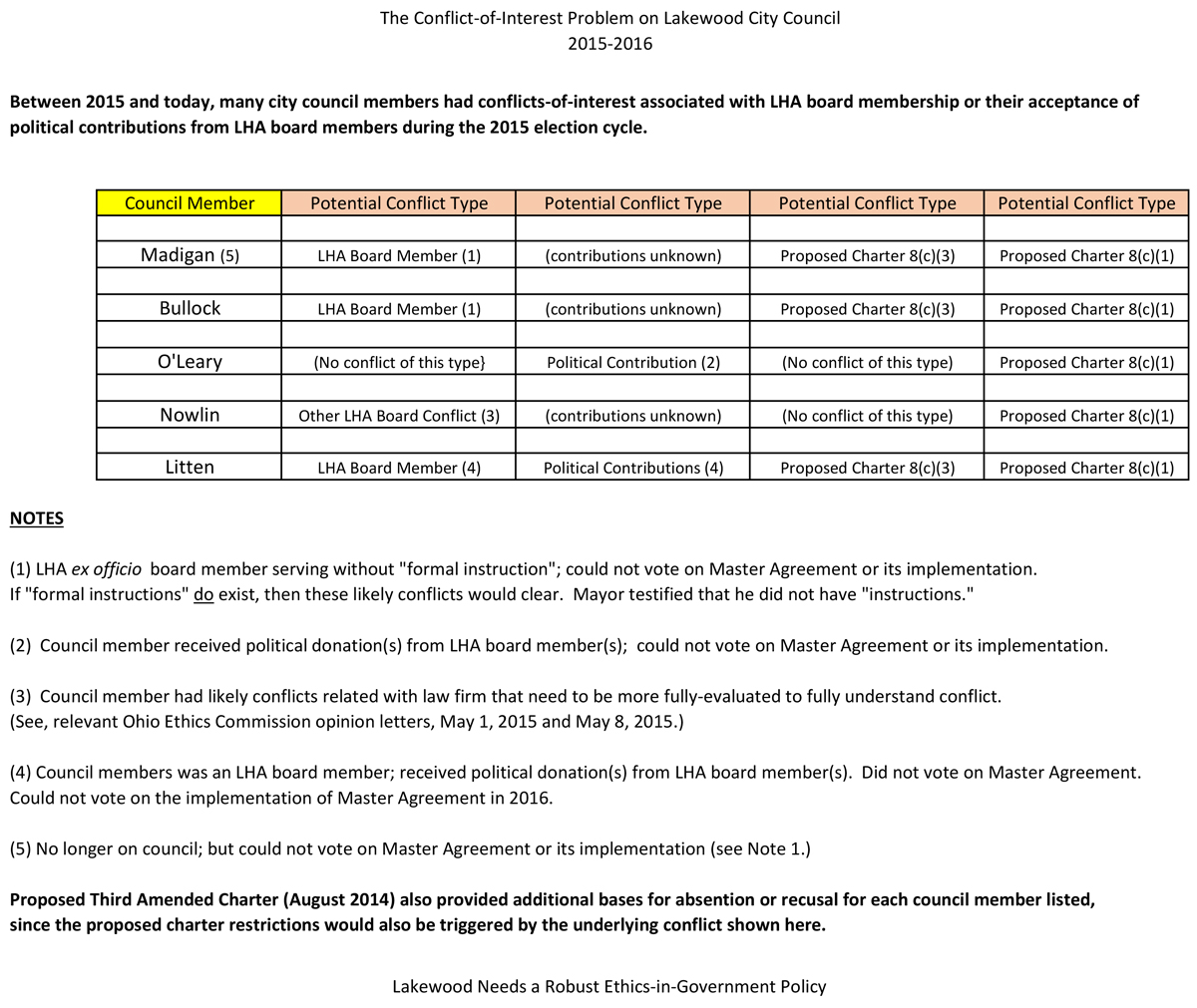
There were obvious conflicts-of interest in the transaction that closed the hospital. Public officials had a clear duty to recognize and avoid these conflicts.
Public officials serving on the board of a CCF-controlled non-profit (LHA) voted to award a multi-million dollar public contract to CCF.
Other public officials received political contributions from board members sitting on the CCF-controlled non-profit and voted to award a multi-million dollar public contract to CCF and/or the implementation of that public contract.
In 2015 and 2016, the majority of city council faced this problem.
How could they ever miss this?
I have illustrated these conflicts on the attached table. If my analysis is wrong, I will review any additional available information and post a corrected table.
There were obvious conflicts-of interest in the transaction that closed the hospital. Public officials had a clear duty to recognize and avoid these conflicts.
Public officials serving on the board of a CCF-controlled non-profit (LHA) voted to award a multi-million dollar public contract to CCF.
Other public officials received political contributions from board members sitting on the CCF-controlled non-profit and voted to award a multi-million dollar public contract to CCF and/or the implementation of that public contract.
In 2015 and 2016, the majority of city council faced this problem.
How could they ever miss this?
I have illustrated these conflicts on the attached table. If my analysis is wrong, I will review any additional available information and post a corrected table.
- Attachments
-
- The Conflict of Interest Problem.pdf
- (86.79 KiB) Downloaded 258 times