

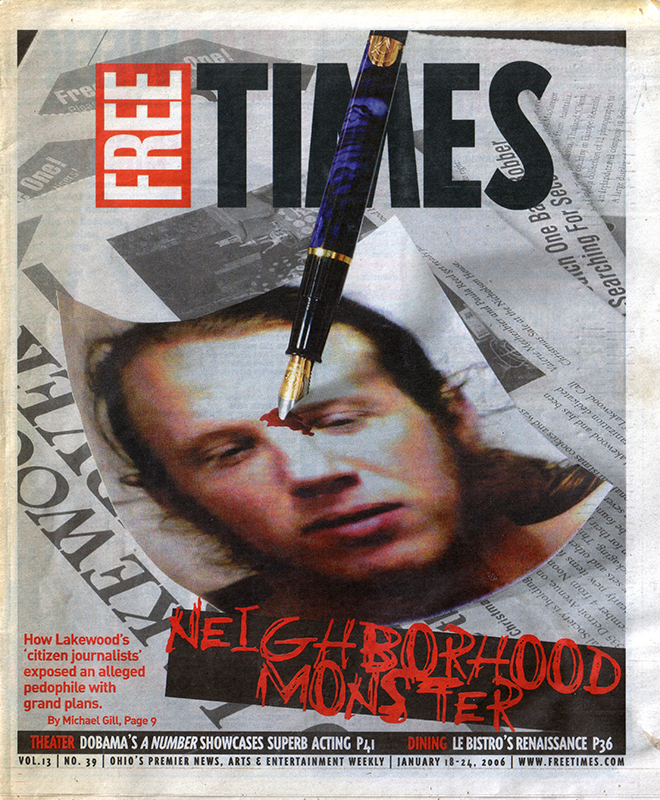
So many are caught up with "Throw-Back-Thursday" I thought this might be a great time to look back, to the Phil Distasio/Brother Petty case. To me, if the entire project came to an end tomorrow, this alone would have been worth everyone's efforts.
Many have have asked, why when I mention a story coming, it does not come within hours, a day, a month or even a year. Because some stories are much more complicated than a simple interview, a couple photos, and a comment or two. Some stories take a lot of work, a lot of background, a lot of digging and a tremendous amount of luck. I am not comparing what the Observer does to the Washington Post and/or the coverage of Watergate, but that is another excellent example of needing everything falling together over the course of a year, to finally get to a part of the story that leads down a long tunnel to the final facts in the case. The Washington Post has a million dollar staff, the Observer does not.
With the exception of one check ending up in the wrong place, and being seen by the right person, completely by accident, the story might have never made it the WATERGATE we know today. Two guys working on a hunch, with a modicum of facts, and the resources of the Washington Post, still needed luck, and 5 seconds of seeing a check in the wrong folder, to uncover one of the largest attacks on Democracy and the voters in the history of America. This is the nature of trying to report what is going on.
The Lakewood Observer is a group of community members with many different beliefs and backgrounds. As witnessed here on the Deck, and any public meeting we have, we rarely agree. We see it as one of our strengths. Working together, in print and here on line, we as a communal group develop story lines on everything from food served at restaurants, events in town, what the sports teams are doing, to fundraisers for non-profits, and allow City Hall, the schools and the library to get information out to the masses. It is through everyone working together, and comments from the damnedest sources, that we have been able to work and break stories big and small in Lakewood and beyond.
So on Throw-Back Thursday, after months of obtaining the rights to copyrighted pieces of various aspects of this very long, very dark story. This allows you, the reader, to see how "mainstream media" saw not just our coverage but how it was done. I have gotten Michael Gill's story on the event from the Free Times. Dan Slife's coverage of the event, and Ken Warren's notes and content so that we can all better understand how this project works. This shows that the printed paper and the Deck work together many times-- The Deck developing the background and discussion on the conclusion, and/or white paper to be printed and distributed to a larger audience.
As in private life talking over the fence, some stuff is just babble, some just conversation for conversation's sake, and some important information. As we are all different, the readers make their own decisions on what information posted is important or not to them.
My thanks to Dan Slife*, Ken Warren, DL Meckes*, Stephen Davis, Stephan Calhoun, and Michael Gill*, for putting these stories together.
* Indicates above all expectations, the amount of work and dedication these people brought to this. DL Meckes, working around the clock behind the scenes, was able to discover thousands of pages about Phil, that when assembled, painted a troubling record of case after case of getting rid of the bad seed to protect names all across the USA and here in Ohio.
About Michael Gill, he has been a resident in Lakewood since 1995, served as Senior Editor at Free Times, Arts Editor at Scene Magazine, Editor of Great Lakes Courier, and is currently Publisher and Editor at CAN Journal (COLLECTIVE ARTS NETWORK) http://canjournal.org.
So without further ado...
Phil Distasio/aka Brother Petty/ aka Brother Pateticus, currently serving 13 life sentences. This story is not for the weak of heart.
Neighborhood Monster: How Lakewood’s Civic Journalists Exposed An Alleged Pedophile With A Grand Plan
by Michael Gill, Published by the Free Times, Volume 13, Issue 39 January 18-24 2006
EVERY CITY TEEMS WITH STORIES, and if you go to the right place you can read them like a paper. One night in May 2005, Dan Slife was in the right place in Lakewood. A student in the college of urban affairs at Cleveland State University, Slife was running on the energy of a new project, a citizen-driven newspaper called the Lakewood Observer. He was in the Phoenix Coffee shop, and he couldn't help but overhear a strange monologue from another guy in the narrow room, a slender man in a floppy hat who called himself Brother Petty. He used it like a real name.
The Phoenix changes moods by the hour, as waves of customers come and go. The early workday rush is followed by moms with toddlers, who make themselves at home with toys. They know each other, and they talk. After school the big kids rule, and then the bigger kids follow a few hours after that. Listen in, and you'll hear the word "dude" quite a bit. You're just as likely to hear the languages of city politics and neighborhood activism.
Slife wanted to write about alternatives to the public schools, so his ears perked up when the guy who called himself Brother Petty began to evangelize about how kids in the system are picked on for being different. Slife introduced himself, and they began to talk.
Petty had heard about the Observer, and he thought that would be a good place to get some publicity for the charter school he wanted to start. The school would let kids be themselves, he explained, expose them to the arts, take them on field trips. As Slife recalls, he seemed particularly "hung up" on the assertion that lesbian and gay kids are pervasively abused in the public schools. He wanted people to know there was nothing wrong with those kids. He wanted to give them "sanctuary," and encouraged kids and parents to check out his youth outreach program, which he called Class Cutters.

In a few weeks, Slife would get to know plenty about Brother Petty. But the stories that resulted weren't the PR boost the friar in the floppy hat had in mind. A few months after his first meeting with Slife, Brother Petty - aka Phillip J. Distasio - found himself sitting in county jail, charged with 34 crimes, including 27 rapes. His victims were children, and the charter school plan was really an elaborate scheme to establish a secret playground for pedophiles.
The region's major media naturally jumped on the sensational story, following up repeatedly with accounts of how Distasio, formerly of Rocky River, trolled for victims and advocated legalization of marijuana. All four of the local TV news crews ran updates at every turn. Newspapers in New Hampshire, where Distasio once lived, picked it up.
But while reveling in the scandalous details, the big news teams ignored the fact that an upstart community paper run by volunteers not only had the story first but led the police to it. Detective Phil Moran of Rocky River says the alleged crimes would not have come to light - at least not so quickly - without the grassroots, ear-on-the- ground work of the Lakewood Observer.
OBSERVER PUBLISHER Jim O'Bryan's office is on the second floor of an old building on Detroit Avenue, overlooking the street. He spends his days juggling time between the Observer and his other business, a graphics company. The phone rings a lot. Nearby a digital sign-making machine quietly cuts vinyl letters.
”I love stupid fun," O'Bryan says. "But from birth to age 51, the idea of starting a newspaper never crossed my mind."
For the first 51 years of his life, most of what crossed his mind was promoting bands, designing graphics, and having a good time. A graduate of Lakewood High, O'Bryan has lived in the city all his life, save a year here and there. In the early '80s he had a warehouse apartment on West 6th Street, and booked local bands like the Wild Giraffes and Lucky Pierre into the space downstairs, which he called Jimmy's Hyena Club. When the Phantasy Theater opened, he took the party back to Lakewood, booking the likes of Bow Wow Wow, the Thompson Twins, and Simple Minds.
In recent years, though, he settled down and built his graphics business. O'Bryan says the only formal training he's had was as a photographer, though he's built a career out of graphics and promotional materials, and branding. The park system built around the Cuyahoga River Valley, for example, may be commonly known as the Emerald Necklace. But he'd like people to think of it as the Emerald Canyon, a name he owns.
O'Bryan talks about people who "drank the Lakewood Kool-Aid," people who "get" Lakewood, and people who don't. He says he loves Detroit Avenue, with its stop-start traffic, the mix of small businesses, and street characters. His faith in the city seems absolute.
He met Lakewood Public Library Director Ken Warren at a cocktail party at the home of a mutual friend, printer Steve Davis, in August 2004. For more than a decade Warren has published a nationally distributed poetry journal called House Organ. Most mornings of the summer Warren can be found meditating at Lakewood Park, to "take the rejuvenating properties of the north wind after it's blown across 50 miles of nothing but fresh water."
Warren has led Lakewood Public Library to national recognition for efficiency and matching the interests of his community. He's done this in part by studying the market, then catering to the interests of the youthful, media-savvy population.
Juxtaposing the demographics with Lakewood's inner-ring predicament, he began to explore brave dreams about what the aging suburb might become. He called a collection of those ideas the Visionary Alignment. Several of its components - including the Lakewood Observer - are in some stage of implementation.
But the Observer's roots can be traced back to another story also broken by a citizen-driven community news source.
In 2001, it was revealed a major retail and housing development in the works for Lakewood's West End. The proposal, which would have taken occupied homes by eminent domain to make way for high-end retail development, divided Lakewood so sharply that 'the two-year-long debate attracted the attention of 60 Minutes and cost the mayor her job.
O'Bryan was an outspoken critic of the West End proposal. And when the development proposal was defeated at the ballot box by the slim margin of 47 votes, he and others who were active in the debate began to look to what else the city's future might hold. As the public discussion grew, O'Bryan - with support from Warren, Davis, and friends, including some he's had since kindergarten - started the Lakewood Observer.
O'Bryan and Warren hoped the paper would help mend fences. They also wanted to advance a set of ideas for the city's future - ideas well outside the conventional wisdom of suburban redevelopment. But above all they decided they would print whatever stories people submitted. They used the phrase "open source." That was a key to their goal, to help the city get to know itself "better than any city ever has."
BROTHER PETTY worked his pieces of the local scene: the Phoenix, the Internet cafe Cyber City, and drum circles. He was usually talking about his plans, such as wanting drummers and dancers to join him every dawn and dusk of the summer at the Stinchcomb Memorial in the Valley. He claimed to be an ordained minister of the Church of THC, and told people that as result, smoking pot with him was constitutionally protected.
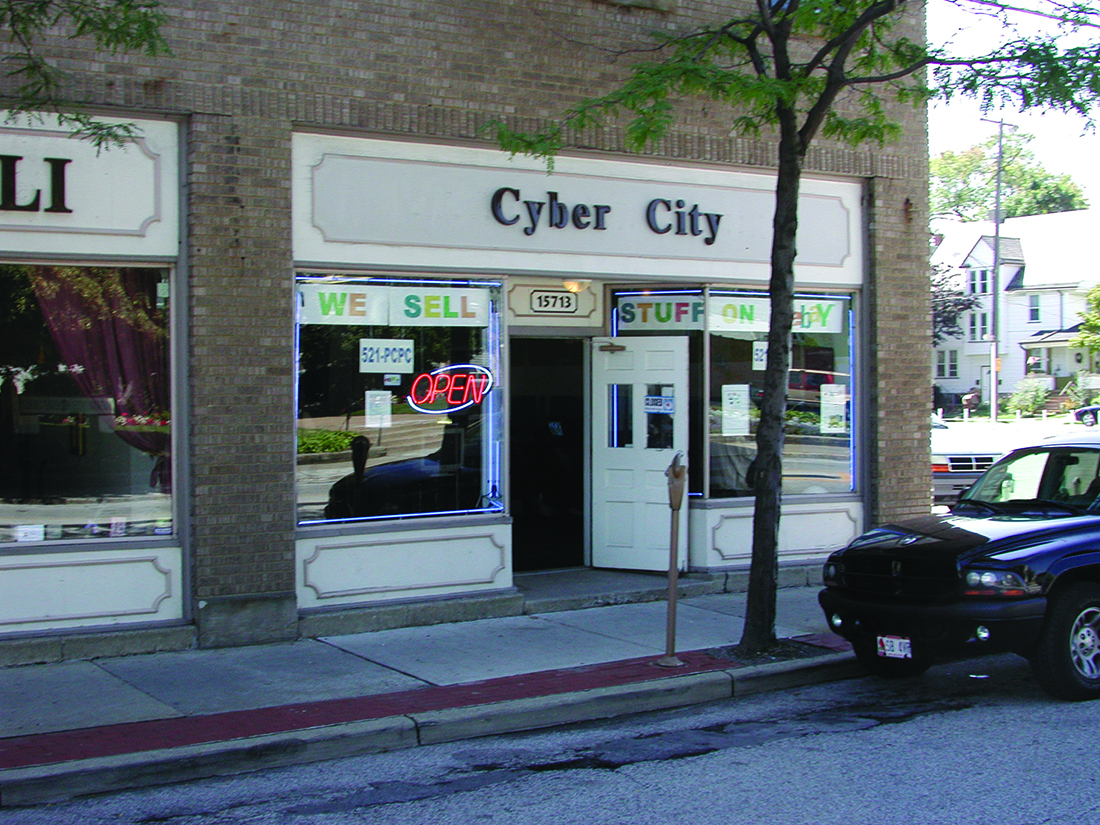
Cyber City, another placed Brother Petty worked, even with "fundraisers featuring beer."
He had another rap about wanting to open an art and performance studio in a storefront. He also thought that opening a youth hostel might be a good way to meet other "travelers." The 34-year-old man bundled his collection of ideas as ''Arcadian Fields," and promoted them in a layered Web site of the same name. He illustrated the site with a combination of classic paintings and photographs of children. He was filling out paper work to establish a nonprofit organization that he hoped would help advance his plans and serve as a conduit for money. In the way of DIY promotion, he photocopied flyers that playfully asked, "What if a friar met a satyr?" He handed out business cards printed with his assumed name, Friar Pateticus.
Encouraged by Warren to pursue a story about Petty, reporter Dan Slife talked with the friar several times in the weeks after their first meeting. Slife says there was a two-·week period during which, by coincidence or not, he saw Petty every day. .. .. •
Then in mid-June, Petty got the Observer's attention in another way, by posting in the newspaper's online forum under his invented name. Steve Davis called him on it.
"He broke the one rule we have," O'Bryan says. "You've got to use your real name. It's about ownership of the ideas and comments."
O'Bryan asked members of the paper's advisory board for input about the guy with the fake name. So the publisher, the library director, and another of the paper's advisors, Steve Calhoun, went to the Phoenix to talk. As they sat around their table, a guy in a floppy hat opened the door and walked in.
"You must be the Observers," he said, reading logos on their T-shirts.
Without ever having seen his face, they recognized Petty, too. And they invited him to pull up a chair.
ABOUT THE SAME TIME as Slife's first meetings with Petty, a hacker going by the name Rikijo posted on an online forum called Alt.hackers.malicious that he had intercepted a letter from Petty to NAMBLA, the North American Man/Boy Love Association. The Observer crew would learn this later in their own online investigation. Alt.hackers.malicious is a small group of Internet vigilantes dedicated to exposing pedophiles.
Distasio envisioned a venue where adults could have sex with children - if they would also join him in masquerading the perverse operation as a charter school. He wasn't just a consumer, but a budding entrepreneur in the sex trade.
The e-mail goes on: "I have gone to great lengths to construct a very elaborate rouse [sic] among which your members will be allowed to hide - so long as they are careful. If we pull this off properly, Nambla will appear to be one of many anonymous donors that are already lined up to contribute to the more publicly acceptable causes that this ministry is set up to support."
SLIFE HAD ALREADY TOLD O'Bryan and Warren about Petty by the time they all crossed paths at the Phoenix. But no one anticipated where the conversation would lead.
In his statement to the Rocky River Police, (see below) Warren says Distasio described his concept of religious sanctuary and the protection of children. He spoke about living in Columbus, and about being disturbed that adults were "cruising for children" at a candlelight vigil for Matthew Shepherd there.
Within 15 minutes, O'Bryan says, they thought there was a possibility that Petty was a pedophile. After half an hour, he thought it was probable. After two hours, he figured Petty was a serial offender. And after three hours, O'Bryan says he thought Petty might have been involved in a murder in Columbus as well.
Warren's police statement quotes Petty as saying: "Toby killed his friend with two bullets to the back of the head." O'Bryan says Petty spoke of the incident in bloody detail. He's not been charged with murder.
O'Bryan says Petty was afraid of Warren's steely gaze. By the end of the meeting, the friar was curled up in his chair shaking.
The next day, O'Bryan told Lakewood Law Director Brian Corrigan, who referred him to the police. O'Bryan and Warren also urged Slife to continue meeting Distasio, probing for details as if to report on his vision of a charter school. The next time they talked, Distasio declared his intentions plainly, and Slife took notes.
"If children are old enough to fight in rebel armies, work in sweatshops, and be fried as adults," Slife transcribed, "they should also have the right to choose whether or not they will have sex and with whom, no matter what age."
Distasio described himself as anarchist on his Web site, but he placed great faith in the protection he believed the legal system would provide.
"By declaring sanctuary," Slife quotes the Friar, "people are exempt from all legal repercussions for their actions within sacred space. Within sacred space, in a controlled environment, children can do whatever they choose to do. I'm in the process of setting up a nonprofit that will have the ability to declare sanctuary for troubled youth. I want to set up an environment where children who point at an adult's penis and say 'I want that' are not reprimanded but encouraged to explore. When I was a minor of age 11, it was my desire to do so."
Slife provided police with multiple witnesses to the conversation.
CITIZEN JOURNALISM is as old as secondhand printing presses. Almost 30 years ago, CSU journalism professor Leo Jeffres published his observations in a book called Grassroots Journalism in the City: Cleveland's Community Newspapers.
Jeffres says he thinks of citizen-driven papers like the Observer as "signs of life" in cities. "Community journalism appears to be a significant indicator that residents identify with their neighborhood and will struggle for its survival," he wrote.
To understand the Observer's mission, it helps to know about Warren's "Visionary Alignment."
The library director rendered it in a triangle graphic: his vision of what might help Lakewood ride out sprawl and the decline of American manufacturing. At the base is the library, the bedrock of knowledge. Social service organizations, a community-based arts group, and the Lakewood Catholic Academy are building blocks of the pyramid, as is the Lakewood Observer: all fairly conventional stuff.
But higher on the pile come things like community-owned retail to buck the trend of exurban shopping malls. Or community currency - the idea that the city could print its own money to keep wealth in town.
And then there was the vision of a "food court of higher education," a plan anticipating that some of the city's many old ethnic churches go up for sale .. Warren suggests that they be marketed to universities of the world, in the hope that some of them would recognize the city's assets - public access to Lake Erie, proximity to downtown, a multicultural, multilingual post-high-school and college population, and street after street of dignified, century-old architecture.
With the Visionary Alignment and helping the city get to know itself at the forefront of their minds, the Observers didn't worry about becoming part of the news when they suspected that they had found a pederast. They didn't hesitate to go to the police.
"All we had was their interview," says Detective Moran. "No probable cause, no right to get into his apartment." Rocky River Police ran background checks, but Distasio had no prior criminal record. But in time they began to get other tips: a boy not yet 13 years old told workers at a health center that Distasio had given him alcohol and smoked marijuana with him. Then came a complaint from one of Distasio's neighbors on Wooster Road. Her young son had given her one of Distasio's Arcadian Fields business cards. She wanted to know what it was about, and Distasio's rap made her suspicious.
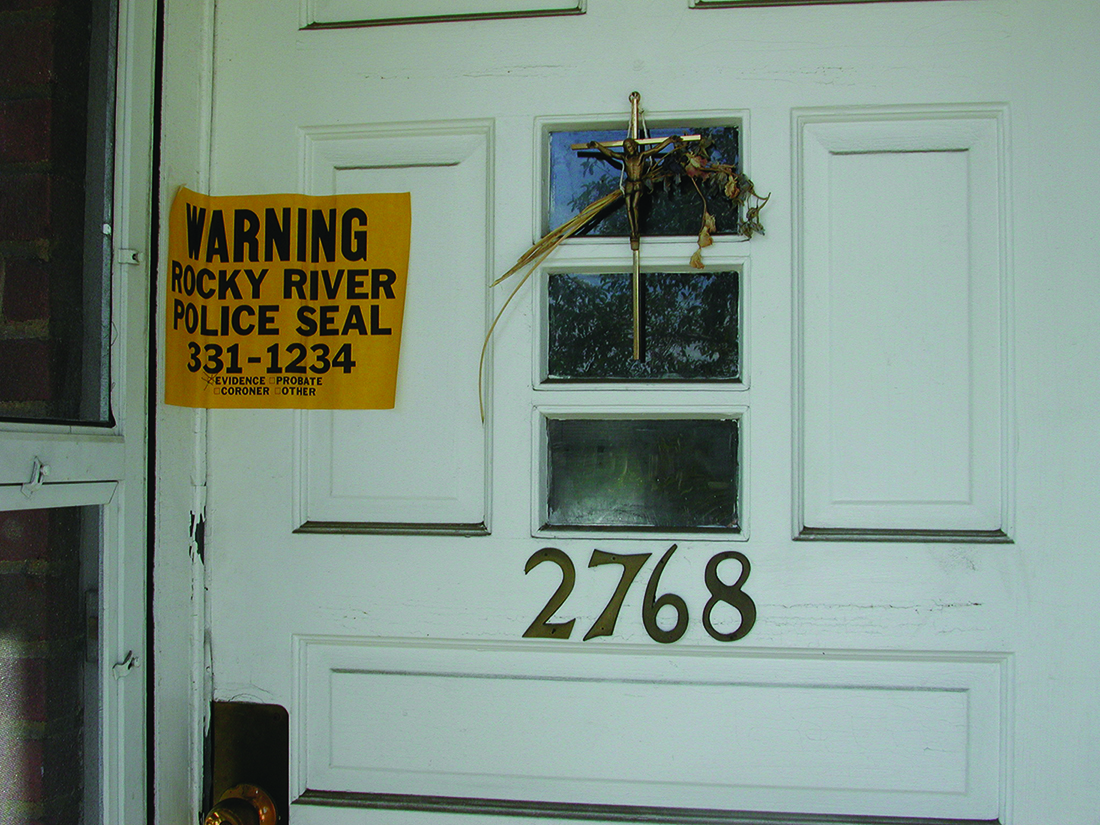
Phil's front door on Wooster.
When police first knocked on Distasio's door, he was with an unkempt young boy. Concerned for the boy's health, the police took him into custody and contacted social workers who interviewed the child and his parents. The boy described sexual conduct between himself and Distasio. Police arrested Distasio the same day.
Reading the friar's journals, Moran says they found information on "eight or nine" additional victims, and says there may be others.
"It's a horrifying thing is what this has turned into," says Moran. "Of the victims we have, they were ages 8 and 9 at the time when there was sexual contact, and/or conduct between each of them and Distasio."
County Prosecutor Bill Mason said the self-described friar's journals detail sexual acts with autistic children. · "What he did was inhumane," the prosecutor says. ''Anyone who preys on the helpless and vulnerable like Distasio did is commiting the ultimate crime."
Mason's office filed 40 additional charges in December, bringing the total to 74 counts. His trial is set for February 6. After the arrest, Slife wrote a dramatic story celebrating the paper's involvement in the investigation and detailing how the Observer crew got wise to 'Petty's agenda.' He praised citizen journalism as a "community firewall."
A few days after the story hit the streets, the body of Distasio's roommate, Chris Nolan, was found in the Metropark with an extension cord wrapped around his neck. Warren covered that in a straightforward, just-the-facts manner.
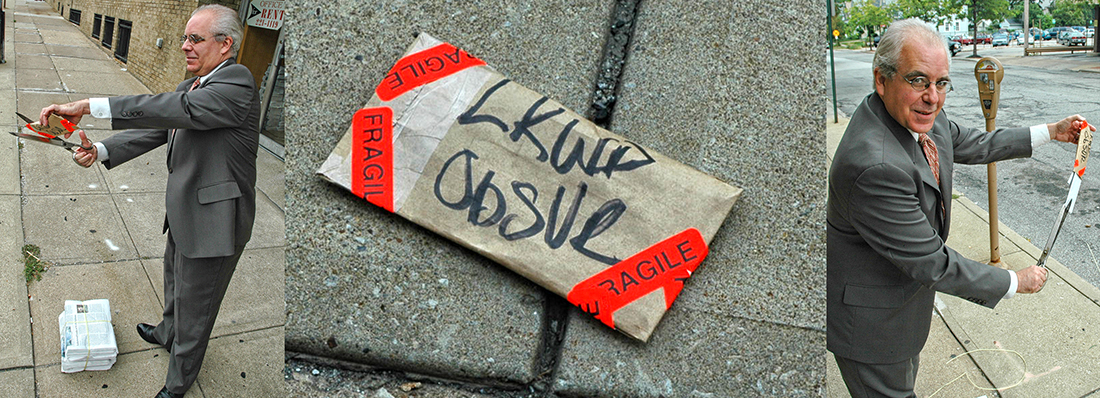
The death threat Chris Nolan pasted to Deb O'Bryan's car, two days before killing himself in Metro Parks. Ken Warren, Director of the Library, came over to open it as he put it, "I get them all the time."
HEIDI HILTY HAS KNOWN Jim O'Bryan since they were . When O'Bryan was talking about starting the Observer, she said, "I'm really busy, but I'll do what I can." But as so often happens with volunteerism, she got sucked in. Now she's the editor.
"I started off thinking I'd work with a couple of writers on a couple of stories," she says. "Now I edit about 20 stories per issue."
To put the involvement of volunteers in perspective, Hilty recalls her work with a high school rock-and-roll orchestra, the Lakewood Project.
"We didn't have a clue if it would take hold. But it took off like a meteor rising, so far beyond expectations that all we could do was hang on. That's how it is with the Observer. I think people are becoming engaged because we are at a crossroads in the community."
The Observer now distributes 15,000 copies of each free, biweekly issue - almost double the paid circulation of the long established Lakewood Sun Post.
The paper's strength is that broad base of volunteers, which offers substantially more reporting capacity than its professional competition. A recent issue offered 24 pages of Lakewood news, including more than 50 headline stories. Among them are reports on the economic impact of Lakewood Hospital, a profile of a local marine back from active duty in Iraq, a story about a fifth-grade boy who decided to fast with a Muslim school friend, and a citizen's vision for converting an idle building in the city park into a coffee shop.
"We really found that we get pretty broad coverage by letting people submit their own ideas," Hilty says.
This has its drawbacks. Some organizations - including the Lakewood Public Schools - have taken advantage of the open-source model by covering themselves. City council meetings are covered by a close ally of the mayor. Hilty sees the humor, but says it would be terrific if each of the city's seven councilpersons had supporters cover the meetings from their perspective.
Warren describes the paper's editorial philosophy - printing whatever the community submits, and, as in the case of Philip Distasio, occasionally becoming part of the story - as "post-ethical and post-professional."
Reporting suspicious characters to the police, for example, is not something journalists typically do. Not that anyone is upset.
As Slife says, "We just got rid of a bad seed.”
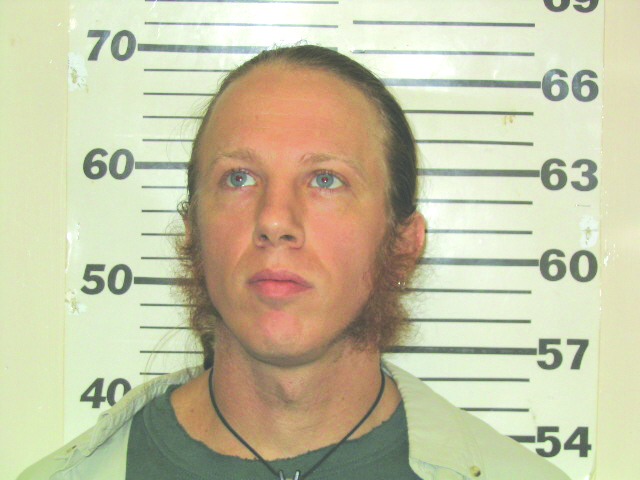
Phil Distasio being booked in Rocky River jail.
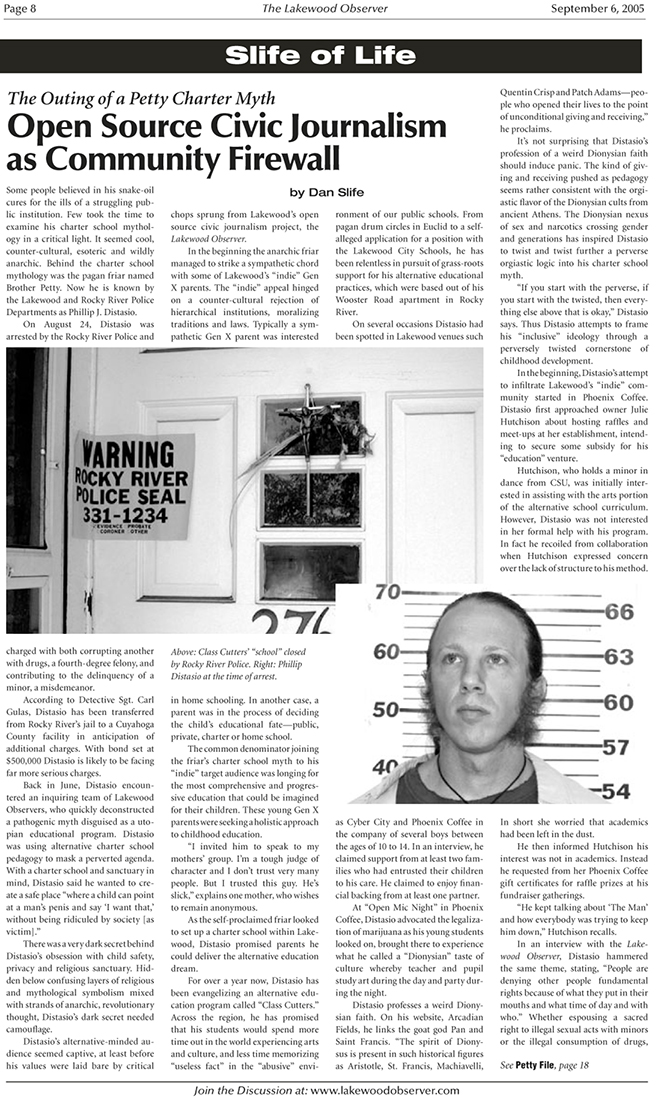
Dan Life's article on the experience.
A link to his article: http://lakewoodobserver.com/read/2005/0 ... ty-charter
A copy of Ken Warren's Statement To Rocky River Police.
Lakewood Observer’s Initial Inquiry into Brother Petty - Phillip J. Distasio
I am the director of Lakewood Public Library and a member of the advisory board of the Lakewood Observer, an open source experiment in citizen journalism that produces a bi-weekly newspaper and electronic forum. As an open source experiment in community building through inclusive and pluralistic participation, the Lakewood Observer is, quite simply, wide open to anyone who can articulate ideas and stories in a manner that will amplify civic intelligence and community good will in Lakewood.
In the process of identifying possible contributors and stories for the start-up publication, Dan Slife mentioned to me that he had met in the Phoenix Coffee House Brother Petty, “an anarchist Jungian shaman” from Rocky River was looking to create a charter school in Lakewood. I suggested that such a curious use of the charter school model by a wild idea anarchist from outside our city would make an interesting and informative story.
I explored the website Arcadian Fields to make sense of the magical, mythological and political thinking behind Brother Petty’s vision.
Dan Slife continued his conversations with Brother Petty about his plans for his charter school.
I believe Brother Petty expected that Dan Slife would write a favorable story in the Lakewood Observer thereby providing credibility to his mission.
On June 15, Brother Petty posted on the Lakewood Observer – Observation Deck electronic forum. One of the rules the Lakewood Observer’s forum is that one must use one’s real name. Brother Petty did not.
Publisher Jim O’Bryan and advisory board member Steve Davis received complaints about the violation of this civic rule.
On Saturday June 25 Jim O’Bryan asked advisory board members for input. We debated about conducting an inquiry as to whether Brother Petty was, in fact, his legal name and whether such a fact would entitle him to post or simply whether he should be deleted from the board. Shortly thereafter, I went to the Phoenix Coffee House with publisher Jim O’Bryan and advisory board member Steve Calhoun to discuss the strategy for informing Brother Petty that a real name is required for posting.
As coincidence would have it, a man noticed us, because we were wearing Lakewood Observer tee-shirts, and I asked him, "Are you Brother Petty?” He was.
We invited him to pull up a chair and began a discussion about the rules of the forum and the need for a real name.
The Lakewood Observer team conducted an intense four hour interdisciplinary inquiry into Brother Petty’s dreams, intentions, life, ministry, mythology, needs and values in light of Lakewood and the Lakewood Observer.
In the process, Brother Petty’s explanation raised among the Lakewood Observer team concerns about his ministry and work with children, particularly his concept of religious sanctuary and the protection of children, along with mention of his agoraphobia. Several comments about his life in Columbus registered with concern among Lakewood Observer listeners. For example, he remarked that he was disturbed adults were cruising for children at the Matthew Shepherd candle rally in Columbus, and that therefore children needed protection. He mentioned he worked with gay children. He said, “Toby killed his friend with two bullets to the back of the head.” In another instance he mentioned “when I talked to the FBI.” At the conclusion of the session we believed his remarks raised the likelihood that he was abused as a child and could possibly be a pedophile trolling for Lakewood children under “indie” charter school guise. We felt he had the capacity to act out.
On Sunday, June 26, publisher Jim O’Brian contacted Lakewood Law Director Brian Corrigan who advised him that the Lakewood Observer team should speak with a detective on Monday.
Lakewood Observer Dan Slife, who was working on the Brother Petty Charter School story, was informed of our concerns and was asked if possible to probe more deeply into his educational philosophy in connection with children and sexual rights. On Sunday June 26, Dan Slife met Brother Petty.
Dan Slife rooted out Brother Petty’s real name, Phillip James Distasio, along with the statements already submitted by e-mail to the Rocky River Police.
Lakewood Observer webmaster dl meckes and advisor Steve Calhoun conducted an Internet search that retrieved data, sometimes using Way Back – the archive of old web data - lending additional credence to our initial assessment that the man could pose harm to the welfare of children.
Publisher Jim O’Bryan filed a police report with the Lakewood Police on Monday, June 27.
On Tuesday, June 28, I made a call to Detective Bussi to discuss the matter further. He suggested Rocky River Police needed to know. I made a call to the Rocky River Police department and was referred to Detective Gulas. After speaking with Detective Gulas, I supplied by e-mail the material Dan Slife had compiled.
On August 26, I was made aware that Phillip J. Distasio has been arrested. I called the Rocky River detective bureau and spoke with Detective Phil Morron to ascertain whether publication of material about Phillip J. Distasio would compromise their case. I was informed it would not. I provided Detective Phil Morron with a brief oral summary of my initial inquiry into Brother Petty. Detective Phil Morron he requested that I submit a written statement on the matter.
Kenneth Warren/August 26, 2005
To everyone who worked so hard on this from DL Meckes, Slife, Warren, Davis and others in Ohio, to those tracking Phil from his days in California, Lakewood Police, Rocky River Police, Lakewood Law Director Brian Corrigan, and the many volunteers putting their time and asses on the line.
I wish developing stories were as easy and fast as everyone thinks.
Thank you.


