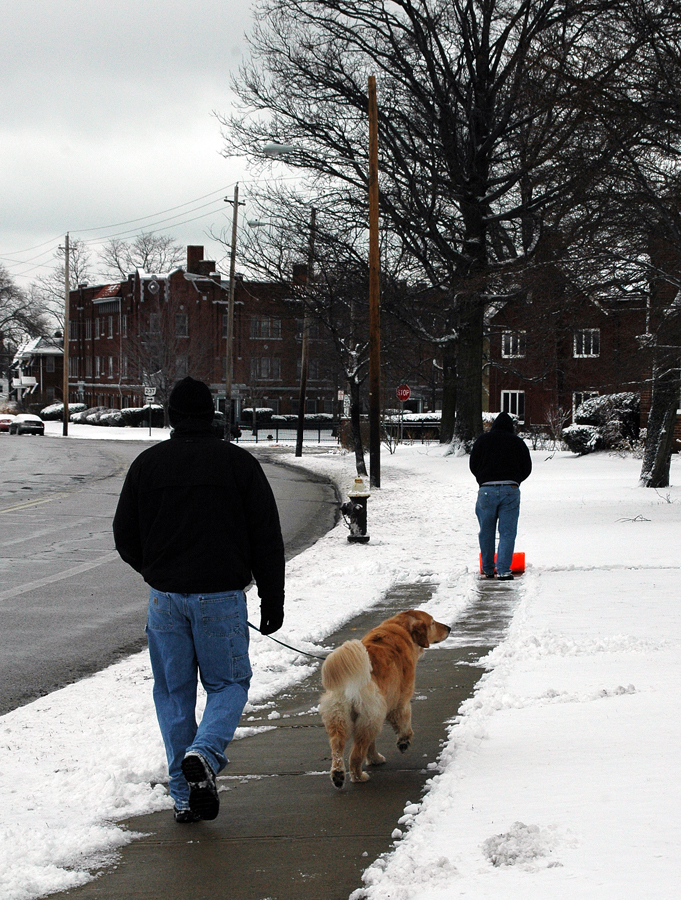
I hope Kristine Pagsuyoin, who moderated this meeting or someone else can also "cover" the meeting here, because even though I attended and took part, I did not take good notes, and missed the very beginning. But discussion clustered around these things:
1. Safety issues. Residents, occupants, property owners (especially on streets like Franklin/Hilliard) are only inconsistently shoveling walks and walkways through intersections, forcing pedestrians off the sidewalks and into the streets, most disturbingly students of all ages coming and going to school. Some commercial property is clearing their own lots and dumping the snow onto the sidewalks.
The problem is compounded by the way the city currently plows streets: large trucks, high speeds and the loss of a "mindset" (Ed Favre) toward pedestrian-friendly plowing. The problem is not just Franklin/Hilliard and it affects more than just students. Ed said that they had a better way to plow in the past, but it has fallen by the wayside, though we still have the smaller trucks that can do better at intersections and be used in a manner that deposits snow more carefully onto tree lawns with less spillage onto sidewalks, utilizing sharper turns, slower speeds and more mindful control. Especially important on Franklin/Hilliard, in places where the tree lawns are very narrow.
The city does use a walk plower to keep clear the sidewalks abutting city-owned property, and their might be a possibilty a the city making use of them in other critical areas as well.
I don't know how, exept by communication or "agitation", we might be able to get the City to go back to methods and equipment Ed spoke of. But it seems like a good idea, and not necessaily one overly costly.
2. Responsibility. The code reads that occupants, owners or anyone in control of a property has responsibility of clearing snow from abutting sidewalks. I find this vague, and feel that the vagueness leads to non-compliance through shoulder-shrugging, finger pointing and buck-passing, but this seems to bother me more than others. What it comes down to, however, is that the owner can ultimately be taken to court, and it’s the owner who will get a warning letter and later a fine for any non-compliance discovered by the City.
Many may not know that it is their responsibility, whether owner/occupant or tenant, so there was much discussion on “getting the word out”. The City currently has a blurb about it on the city website (on the Department of Housing and Building page), and there is mention of it on water bills (which tenants don’t see of course), but more could be done to help everyone know about responsibility, including circulars distributed by individuals, neighborhood associations, the City (like garbage and leaf communications) and the Schools (possibly by “backpack” take-homes).
Snow Removal assistance for seniors is offered through the Division of Aging office. Call (216) 521-1515 for further information.3. Enforcement. Mary Simon, of Lakewood’s Division of Housing and Building, along with Ed Favre, as a long time Lakewood resident, just-retired police officer and current School Board member, spoke to the means of enforcement. The police can, apparently, hold anyone in control of a property, including tenants, responsible and issue a citation for violation of the Code, and even ticket a manger of a business. Apparently a surprising amount of enforcement of another kind is already happening: Mary has sent out about 200 letters in 2011 alone from her department to owners where she herself has inspected neglect of sidewalks, or when a citizen complaint reaches her desk, and five days later an follow up inspection is done to see if the problem has been fixed. If it isn’t, owners are fined $100.
I think this is an indication that owners are in reality made more responsible than tenants, when it comes to enforcement. Landlord-Owners can be tracked down using County property data (by anyone), and if the contact info is “shrouded” by a landlord using the rental property as his/her mailing address, then property tax info (where the tax bill gets sent), also available to anyone I think, can be used to get a real address. Tenants are harder to track.
Getting the word out for enforcement becomes important here as well, as a separate issue from notifying people of their responsibility. If people knew “who to call” (Mary) about unshoveled walks, there could be many more complaints processed (which Mary said they could in fact handle), inspections made, owners notified, and a more consistent deterrent established to neglecting sidewalks. If more landlords get the picture, more arrangements with tenants can be explicitly made a part of the Rental agreement. (I’d like to see Mary’s phone number go out in backpacks to Moms every October, as they can best discover major problems on their way walking to schools.)
City of Lakewood “Report a Problem”: http://www.onelakewood.com/ReportProblem/. These will be routed to Mary Simon, Litter Control and High Grass Officer, Department of Housing and Building, City of Lakewood.
Phone number to report a sidewalk snow issue: (216) 529-7697 (Mary Simon)
Mary’s email: Mary.Simon@lakewoodoh.net4. Community involvement. Many people spoke of their experience organizing their street, block, etc. to help get the word out, help with shoveling, “Adopt-A-Sidewalk” and other things. I will let someone else speak to these things. In short, the more we are concerned and put our concern into actions of our own (and not just looking to the City), the better things can be. We are imitative creatures, and being active, creative and communicative about improving things amongst ourselves is contagious.