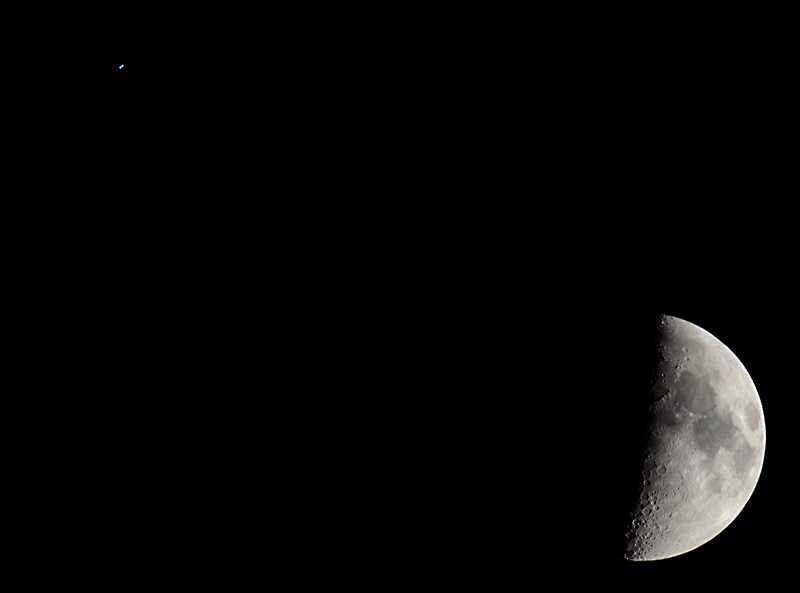
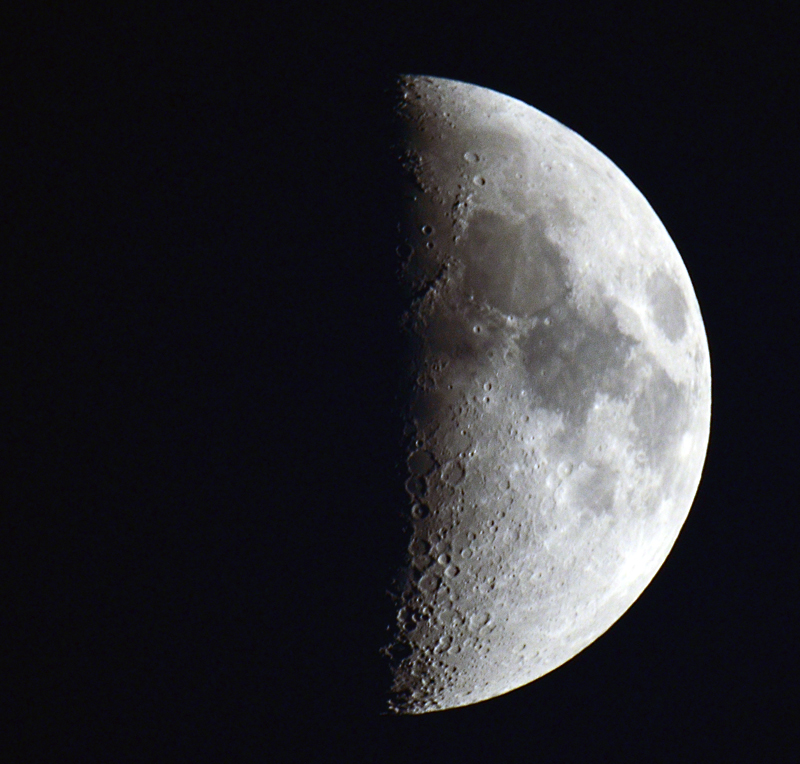
Peter
No photoshop. It is actually very amazing to me. I am sitting with a camera and a 1000mm lens
looking up to the heavens. I was amazed at what appeared to be new craters on the moon. A surface
that rarely changes, when I noticed that Saturn was near the moon.
This was about 7pm and the sky was still blue.
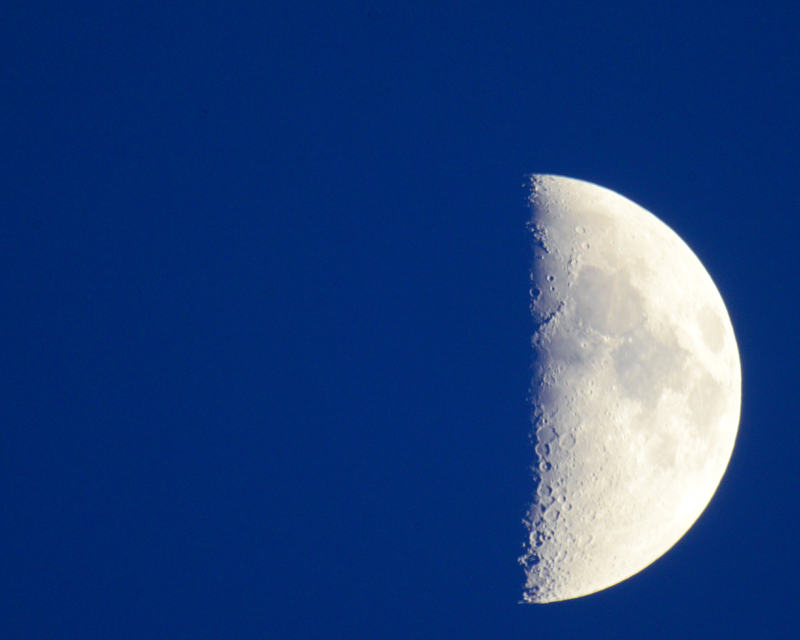
Again not photoshopped, against the blue of the sky. At this point Saturn is in the photo but you
cannot see it and I actually thought the the "Zuben Eschamali" was Saturn until it got darker and I
realized that it was not Saturn but Zuben Eschamali the bright star of Libra. Then slowly Saturn
became brighter and brighter as the sky got darker and darker.
But what still amazes me, is the Babylonians realized that was a planet not a star, around 1894 BC.
Think about that!
It is amazing to me that Galileo through his crude homemade telescope could see and start to map
Jupiter and 7 of its moons. Yet through these modern lenses it was merely a white dot.
Again, just amazing.
JUST IN! 8,000 BC!A team of archaeologists at the University of Birmingham may have found the earliest evidence of human time keeping activity. In a paper published earlier this week, the researchers announce that they have discovered a 10,000-year-old lunar calendar, etched in the earth near Aberdeen, on Scotland’s North Sea Coast.
http://blog.longnow.org/02013/07/16/oldest-record-of-time-keeping-found-in-scotland/.